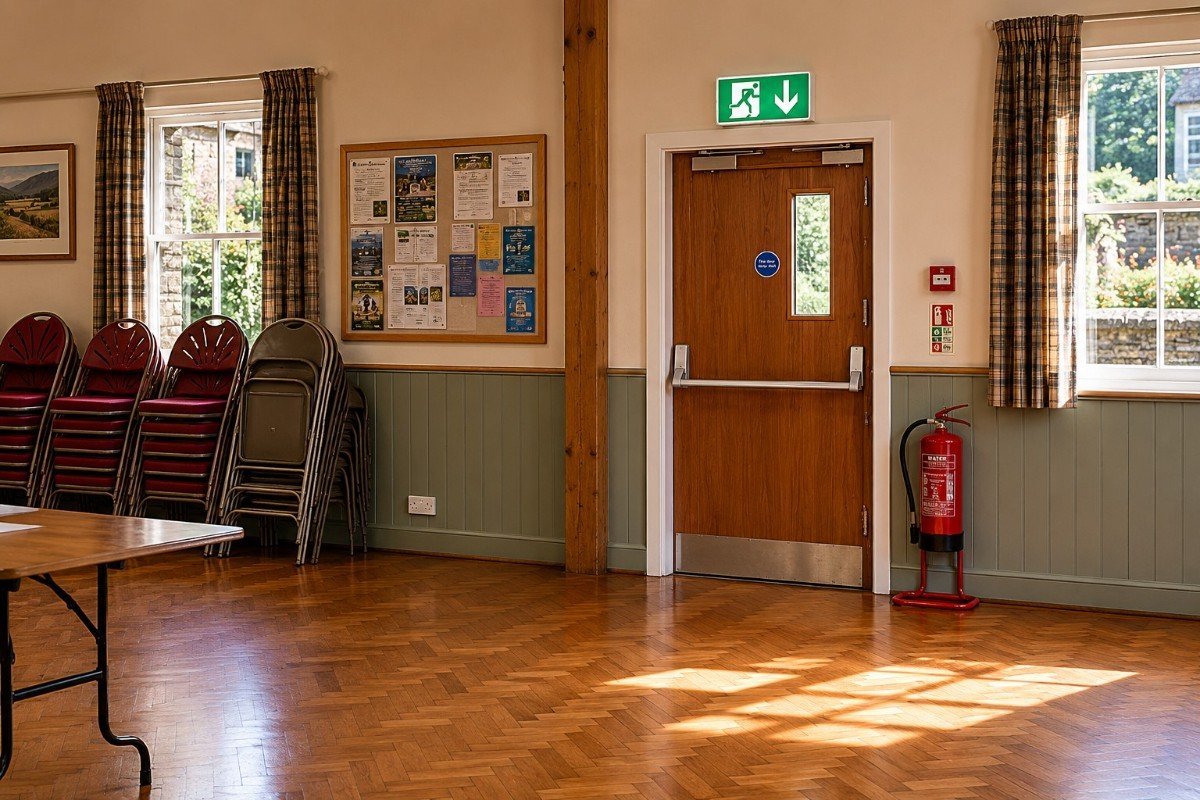
Late summer is when most community halls go quiet. Regular groups break up, the diary thins out, and the building sits largely unused for a few weeks. That gap is the perfect moment to get the fire doors checked, fix any faults and make sure the hall is ready before the autumn programme fills the bookings back up.
A village or community hall carries the same fire safety duties as any business open to the public. Whoever controls the building, which for most halls is the management committee or the trustees, is responsible for keeping people safe from fire. Fire doors are one of the main things they must keep in good working order, and they are easy to overlook until something goes wrong.
Why fire doors matter in a community hall
A fire door is much more than a heavy door. It is built and tested to hold back fire and smoke for a set time, usually at least thirty minutes in a hall. That time is what lets people get out safely and gives the fire service a building they can work in.
It only does that job if every part is intact: the door leaf, the frame, the seals around the edges, the hinges and the self-closing device that pulls it shut. If any one of those is damaged, painted over, propped open or missing, the door can fail in a fire and leaves a gap in the building’s protection.
Halls are especially prone to slow, unnoticed damage. Doors get knocked by trolleys during set-ups, self-closers get disconnected because they slam too loudly, and the thin seals along the edges get painted over on a redecorating weekend. These are some of the most common faults found during fire door checks.
What a fire door check covers
A competent inspector goes through each door against a clear list: the condition of the leaf and frame, how well the door sits in its opening, the gaps around the edges, the seals, whether the self-closer pulls the door fully shut, and whether the hinges are secure and the right type for a fire door.
Anything that falls short gets flagged with a recommendation. Some fixes are quick, such as a replacement seal or a new self-closer. Others are more serious, such as a door leaf that has been cut down or modified over the years, which may need a full replacement.
If fire safety measures are not kept up, the people in charge of the building can be held responsible. A fire door propped open or missing its seals is exactly the kind of fault that gets picked up in a fire service inspection.
What the law expects of you
As the people in control of the premises, the committee or trustees are expected to have a fire risk assessment in place and to keep fire safety measures, including fire doors, in good working order. There is no fixed legal interval that says a hall’s fire doors must be checked every few months. Your fire risk assessment is what decides how often the doors are checked and by whom, which is why keeping it up to date matters so much.
Why late summer is the right time
There are practical reasons to book the work now rather than waiting for September. The hall is empty, so an inspector can reach every door, including the ones in store cupboards, kitchens and back corridors, without working around classes or meetings.
If any remedial work is needed, getting the check done early leaves time to sort it before the programme restarts. Replacement doors and parts can take a few weeks to arrive, so spotting the problem now means fitting can happen while the hall is still quiet. It is also a natural point to look over your fire risk assessment again, so everything is current when new hirers sign up.
A quick pre-autumn checklist for hall committees
Before the diary fills up again
- Walk the building and check every fire door closes fully into its frame without sticking or catching.
- Confirm all self-closers work and have not been wedged, tied back or disconnected.
- Look along the edges of each fire door for the seals. If any are missing, painted over or damaged, note them for replacement.
- Check that “Fire Door Keep Shut” signs are in place and easy to read on every relevant door.
- Review your fire risk assessment and confirm whether anything has changed. If it is out of date, arrange a new one before the autumn term.
- Test the fire alarm and emergency lighting, and record the results in your fire safety logbook.
A professional inspection every six months is widely treated as good practice for fire doors, with simple visual checks by the committee in between. If you are on a hall committee anywhere in Cumbria and want a professional check before autumn, Beacon Fire Protection can help.
Frequently asked questions
How often should fire doors be checked in a community hall?
There is no fixed legal interval for halls. You are expected to keep fire doors in good working order, and a professional inspection every six months is widely treated as good practice, with regular visual checks by the committee in between.
Who is responsible for fire safety in a village hall?
Whoever controls the building. For most community and village halls that is the management committee or board of trustees, who hold the duty to have a fire risk assessment and keep fire safety measures, including fire doors, maintained.
What does a fire door check look at?
An inspector checks the door leaf and frame, the gaps around the edges, the seals, the self-closer and the hinges, then flags anything that needs repair or replacement. Quick fixes like a new seal can often be done on the spot.
Sources
- Home Office and gov.uk guidance on fire safety responsibilities for non-domestic premises, including community and assembly buildings.