Every new member of staff who joins your school in September needs to understand fire safety before they supervise a single child. As the person responsible for the premises, usually the headteacher or governing body, you are expected to make sure employees get proper fire safety training. For a school business manager, the sensible move is to plan that training now, while the diary is still open, rather than in the rush of the autumn term.
This guide sets out which fire safety courses new staff need, who counts as a fire marshal in a school, and how to get everyone in your team trained before the first bell rings.
What fire marshal training is for
Fire marshals are the staff who take charge during an evacuation. They sweep their designated area, check toilets and store cupboards, make sure everyone reaches the assembly point and can be accounted for, and meet the fire service when it arrives. In a busy school full of children, that job needs people who have been shown how to do it, not just told.
As the responsible person, you must give employees adequate fire safety training when they first start, and again whenever their role or the risks around them change. So a new teaching assistant, caretaker, administrator or lunchtime supervisor starting in September should be trained before they begin working unsupervised. A short induction chat does not meet that duty.
How many fire marshals does a school need?
There is no fixed number set in law, and no official ratio of marshals to pupils or floors. What matters is that you have enough trained, competent people to carry out a safe evacuation. Your fire risk assessment is what decides the right figure, based on the layout of the building, how many people are usually inside, and how staff are spread around the site.
In practice, most schools plan cover for each floor and for any separate buildings, then add a few spares so absence never leaves a zone uncovered. New staff stepping into a marshal role need formal fire safety training before term begins.
The gaps that catch schools out
The most common problem is timing. Schools often recruit late, sometimes well into August, and assume induction week will cover everything. A 20-minute slideshow on the first day is not the same as proper training, and it leaves a gap on the very day new staff first take charge of children.
The second gap is coverage. Schools tend to train teachers but overlook support staff. Lunchtime supervisors, breakfast club assistants and visiting music teachers are all on the premises, and any one of them might be the only adult in a room when the alarm sounds. They need fire awareness training too.
The third gap is records. You are expected to keep your fire safety arrangements under review and to be able to show that training has actually happened. A simple log of who was trained, on what, and when is enough to cover this.
New employees should be trained by the time they start work. If staff begin on the first day of term, their training should already be complete. Booking early keeps you covered from day one.
What courses should Cumbria schools book?
For most schools, two courses cover it: fire marshal training for the staff who will act as marshals, and fire awareness training for everyone else. Schools with nursery or reception classes should also plan for paediatric first aid, which is a separate requirement for early years settings and needs at least one certificate holder on site whenever young children are present.
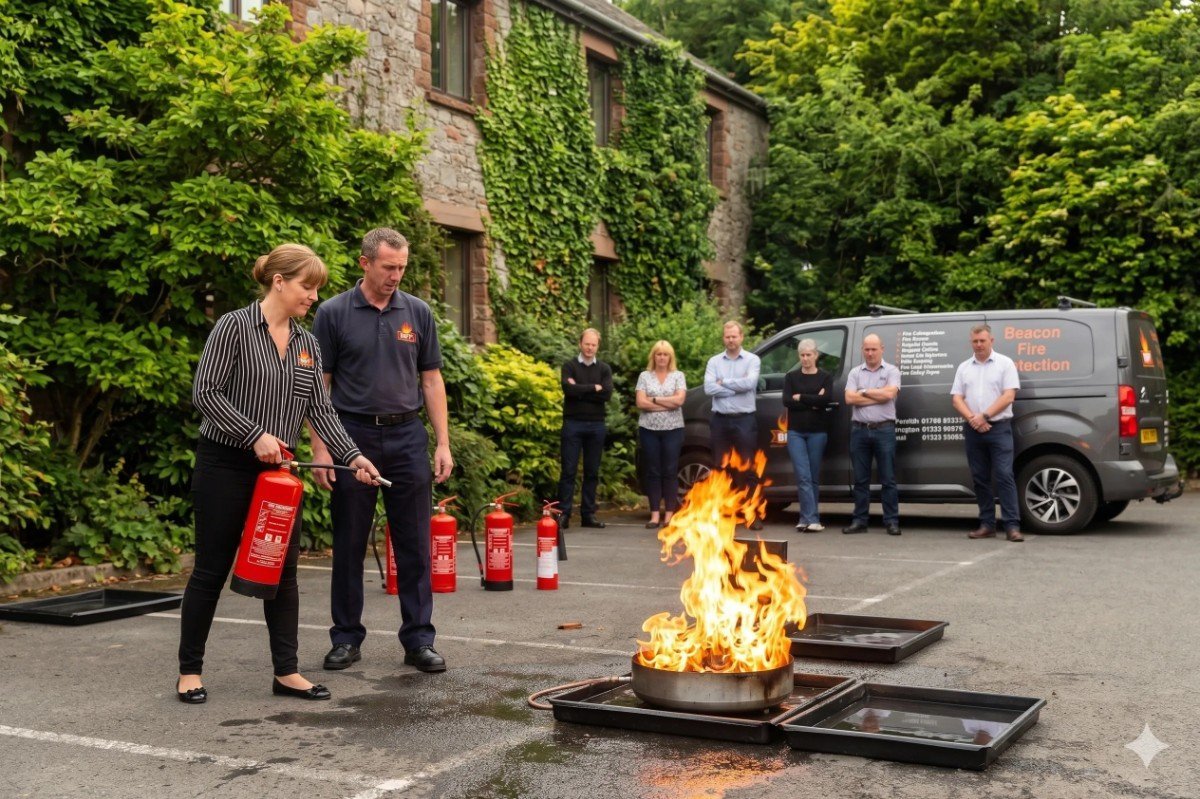
Cumbria Fire Safety Training delivers fire marshal training in person, either at your school or at our Penrith training centre. Courses are CPD accredited, run for half a day, and cover how fire behaves, using extinguishers, evacuation procedures and the responsibilities of a marshal. Staff leave with a certificate and the confidence to lead an evacuation. Our trainers travel right across Cumbria, and an on-site group booking is usually the easiest option once you have five or more staff to train.
Before the autumn term
- Identify all new starters and confirm which of them will hold fire marshal responsibilities.
- Review your fire risk assessment and decide how many trained marshals it justifies.
- Book fire marshal training for new marshals through upcoming courses or request on-site delivery.
- Arrange fire awareness training for the rest of your new staff, including TAs, admin and lunchtime supervisors.
- Update your evacuation plan with new names, zones and assembly point roles.
- Schedule a full fire drill in the first two weeks of term to test the updated plan.
Fire marshal training: your questions answered
How many fire marshals does my school need?
There is no fixed legal number. You need enough trained people to carry out a safe evacuation, and your fire risk assessment decides what that is, based on building layout, occupancy and staffing. Many schools cover each floor and separate building, plus a few spares for absence.
How often does fire marshal training need refreshing?
There is no legal deadline for refresher training. The requirement is to train staff when they first start and whenever risks change. An annual refresher is widely treated as good practice, and many schools choose to do one, but it is a recommendation rather than a rule.
Can fire marshal training be done online?
Fire marshal training involves practical skills such as using an extinguisher and leading an evacuation, so we deliver it in person, either at your school or at our Penrith training centre. Staff get hands-on experience they can use straight away.
Sources
- Fire safety duties for employers and responsible persons, GOV.UK.
- Statutory framework for the Early Years Foundation Stage, GOV.UK.