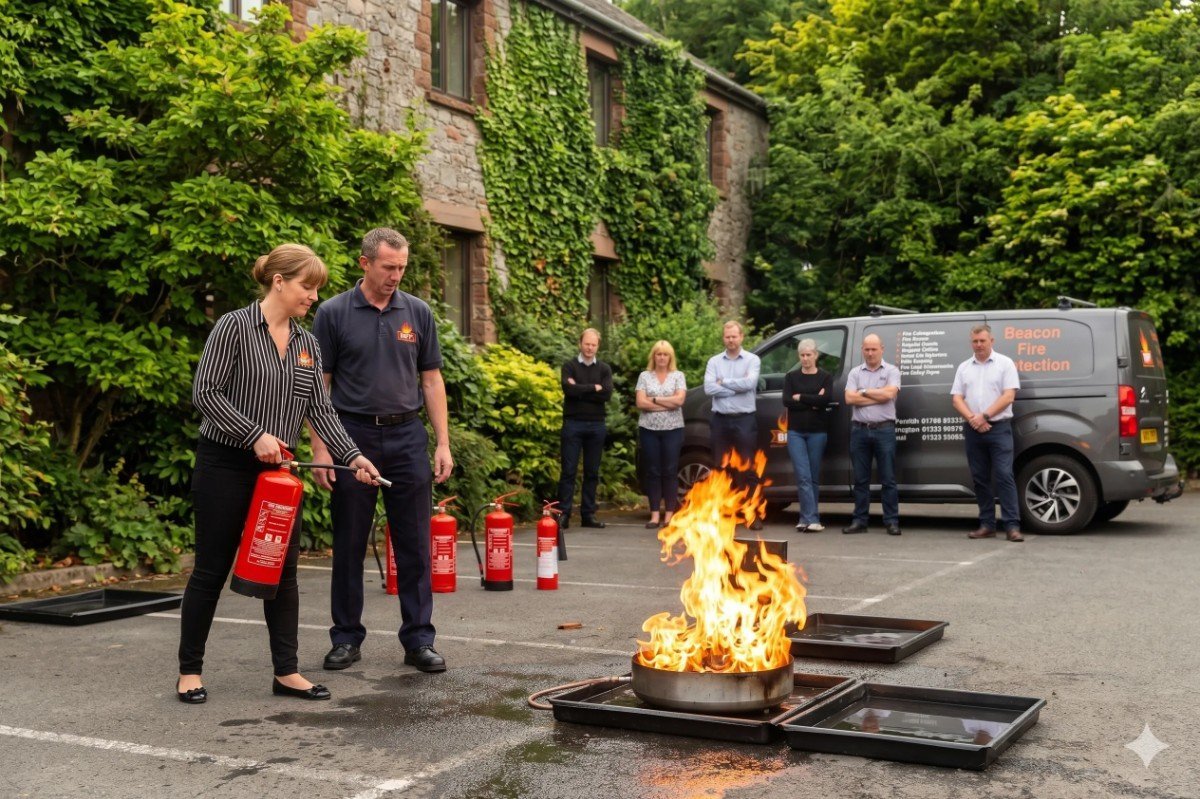
A catering van or food stall at a Cumbria show is a small premises with hot oil, gas and electrics packed into close quarters. The law treats it that way too. Whatever the event organiser does across the wider site, the person running each unit is responsible for managing its own fire risk. This guide for outdoor event traders sets out what that means: the right extinguishers, safe gas, a written assessment and the checks to do before you trade.
What outdoor event traders are responsible for
Fire safety law does not only cover fixed buildings. It applies to almost all business premises, and that includes catering vans, gazebos, pop-up kitchens and food stalls at agricultural shows, festivals and markets across the county. As the person operating the unit, you carry the duty to manage its fire risk.
Part of that duty is carrying out a written fire risk assessment for your setup. This need not be a long document. For a single catering van, a focused assessment covering your cooking equipment, gas supply, electrics, escape route and firefighting kit is usually enough. The point is that you have thought it through and written it down.
Some traders assume the organiser’s risk assessment covers them. It does not. The organiser manages site-wide safety, but each trader is responsible for their own pitch. An enforcement officer or the event safety team can ask to see yours at any time.
The mistakes we see most often
Working with traders and event organisers across the Lake District and wider Cumbria, we see the same issues come up again and again. Most are easy to fix once you know about them.
No fire extinguisher, or the wrong type. A chip van running deep fat fryers needs a wet chemical extinguisher rated for cooking oil and fat fires (Class F). A standard dry powder extinguisher is not suitable for cooking oil fires. Many traders turn up with a single powder extinguisher and assume they are covered. They are not.
Expired or unserviced extinguishers. Extinguishers should be serviced once a year by a competent person. If yours has not been checked in the last twelve months, it may not work when you need it. We provide fire extinguisher servicing across Cumbria, so there is no excuse to trade with out-of-date kit.
No written risk assessment. Your unit, your risk assessment. An enforcement officer or the event’s safety team can ask to see it at any time, and a verbal “I’ve thought about it” is not enough.
Gas cylinders stored badly. LPG cylinders should be kept upright and secured so they cannot fall, ideally outside the unit and away from anything that could ignite them, with the connections checked before each event.
Blocked escape routes. Stock boxes, cool boxes and queuing customers can all block your way out. You need a clear path out of your unit at all times. If your van has a single door, nothing should be in front of it.
What to have on-site before you trade
Pre-event fire safety checklist for food traders
- A written fire risk assessment for your unit, covering cooking, gas, electrics and escape.
- The correct extinguisher for your cooking method: wet chemical for deep fat fryers, CO2 for electrical equipment, serviced within the last twelve months.
- A fire blanket within reach of cooking surfaces, not behind or above the heat source.
- LPG cylinders upright, secured and outside where practical, with connections checked for leaks before trading starts.
- A clear, unobstructed way out of your unit at all times during trading hours.
- All staff briefed on how to use the extinguisher, where the fire blanket is and what to do if they need to get out.
Why the summer season is the time to sort it
The warmer months are the busiest for outdoor events across Cumbria. Agricultural shows, food festivals and community events run almost every weekend, and pitches get packed close together. High footfall, several cooking units side by side, warm weather and sometimes limited water all make outdoor events a higher-risk place to trade than your usual spot. A fire at one stall can spread to neighbouring traders within minutes if units are too close or combustible materials are stored between them.
If you are trading at events across the Lake District this summer, sort your fire safety before the season picks up. Once you are running back-to-back weekends, there is no spare time to arrange servicing or write up an assessment.
Frequently asked questions
Do I need a fire risk assessment for a catering van at an outdoor event?
Yes. The person operating a catering van or food stall is responsible for it and should carry out a written fire risk assessment for their unit. This applies at every event you attend, though one assessment can cover your standard setup where conditions are similar.
What extinguisher do I need for a food stall with deep fat fryers?
You need a wet chemical extinguisher rated for cooking oil and fat fires (Class F). A standard dry powder extinguisher is not suitable for deep fat fryer fires. You should also keep a fire blanket within easy reach of cooking surfaces.
Does the event organiser’s risk assessment cover my trading unit?
No. The organiser is responsible for site-wide fire safety, but each trader is responsible for their own pitch. You need your own written risk assessment, your own extinguishers and your own staff briefing.
Sources
- Fire safety law and guidance for those responsible for non-domestic premises (gov.uk).
- Storing and using LPG at events and elsewhere, Health and Safety Executive (hse.gov.uk).